Writing fundamentalsLesson 1 of 3
Starting content writing: the above the fold area and fulfilling search intent
Ammar Ashfaq's SEO Class 5 on why content is the backbone of on-page SEO, starting from the main and related keywords, and fulfilling the page's intent in the above the fold area.
- Status
- stable
- Trust
- unverified
This chapter records the content writing part of Class 5 of the SEO module, taught by Ammar Ashfaq. The first part of the class, on keywords in other languages, is in Keyword coverage and grouping, Class 5.1
Content is the backbone
After keyword research, grouping and site structure, the class moves to content writing.
- The content of every post and every page is made separately.
- In on-page SEO, content writing is the backbone. If the content is not good, there is no SEO.
- If the content is good, sometimes off-page SEO is not even needed.1
Note
The infographic adds a reality check: skipping off-page can hold for easy keywords, but for competitive keywords backlinks and brand mentions usually still matter, so test it on your own site first.2
How to start
First take the main keyword, and below it write its related keywords. Content writing starts on the basis of that list.1 The main keyword and its related keywords are the groups built in Class 4.
Above the fold
When a page opens, the area or content you see before scrolling is called the above the fold area. It is the most important part of the content, and it holds three things:
- Main intent of the page
- Page meta
- Intro1
Read your keyword to find its intent; your job is to fulfil that intent. Page meta and the intro come later.1
Fulfilling the intent: the teacher's examples
| Keyword | Fulfil the intent with |
|---|---|
| download mod apk | A download button |
| alternative of magis tv | An initial list or links |
| magis tv link downloader | A tool |
These three keywords are the teacher's own examples.1
The infographic shows the same idea with its own keywords: "download pdf editor" with a clear download button on the first screen, "alternative of canva" with an initial list or links of the alternatives, and "image resizer online" with a working tool the visitor can use right away.2
Caution
The teacher's examples are mod apk and streaming app keywords. As noted in Class 4, such keywords can carry malware, piracy and brand-owner risk; use them to learn how intent is fulfilled, not as a niche to build.
Assignment
For every group's main keyword, write what its intent is and how you will fulfil it.1 This is step 4 of the Class 5 assignment; the first three steps (find your niche's keywords, group them, build the site structure) are in the keyword part of the class.
Class infographic
Class infographicTap the image to zoom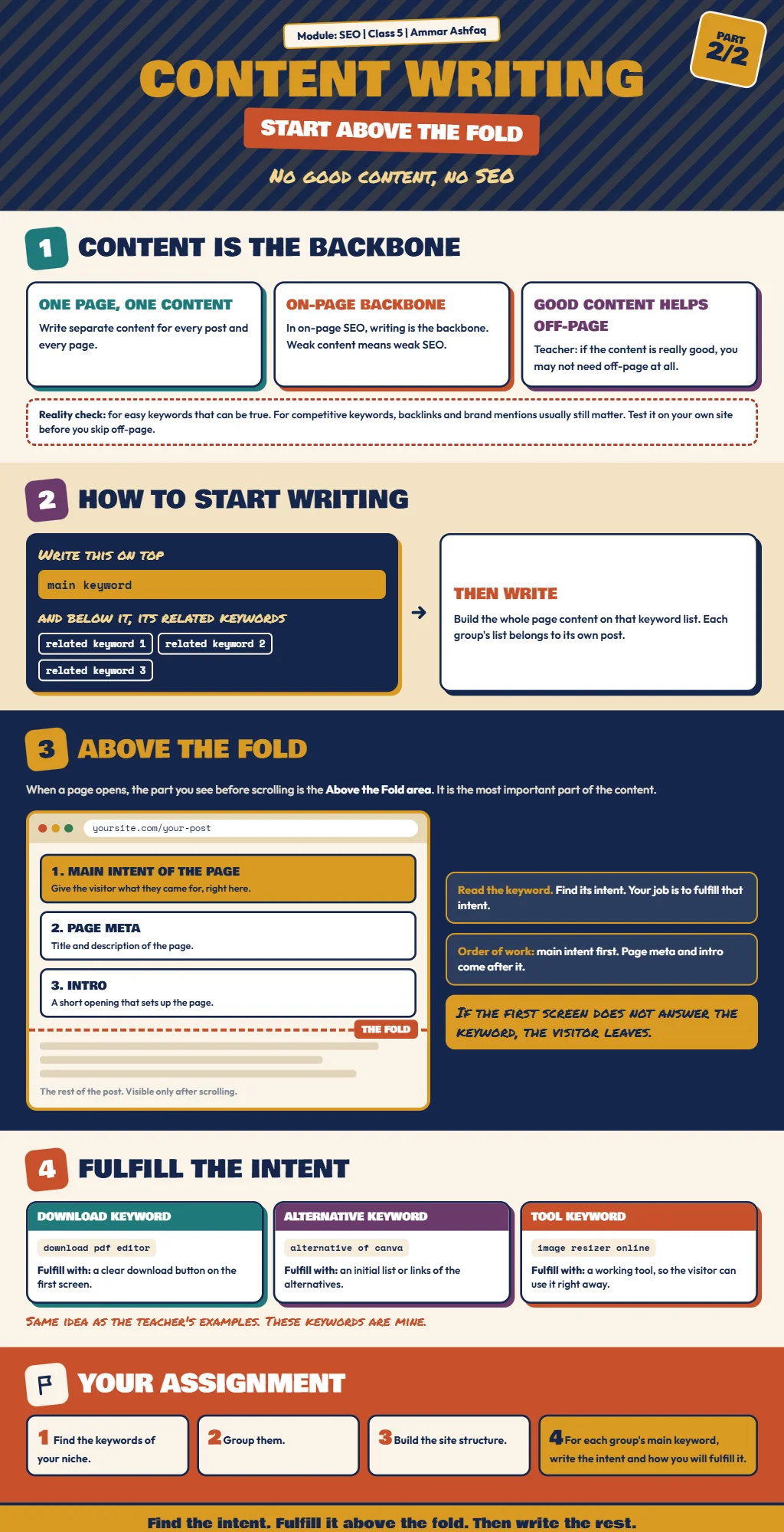 Starting content writing, Class 5: the above the fold area and fulfilling search intentOpen full size
Footnotes
More in this chapter2
- LessonArticle structure: headings, competitor analysis, and keyword prominenceHow to structure an SEO article with HTML headings, build it from competitor heading analysis, and place the main keyword for maximum prominence.Read lesson
- LessonSEO content writing: HTML formatting, structure, and copywritingA complete guide to writing SEO-optimized blog content: HTML tags, blog post structure, competitor SERP research, content density, and emotional copywriting.Read lesson