Grouping and site structureLesson 3 of 3
Keyword coverage and grouping, Class 5: keywords in other languages
Ammar Ashfaq's SEO Class 5 on choosing a niche's region and language, building a multilingual site, grouping non-English keywords with GOOGLETRANSLATE, and the minimum volume for a post.
- Status
- stable
- Trust
- unverified
This chapter records Class 5 of the SEO module, Keyword Coverage & Grouping, taught by Ammar Ashfaq.1
The keyword research and content planning from the last class is done again here in another language. The concepts are all the same.1
The second half of the class starts content writing; it is recorded in Starting content writing: the above the fold area and fulfilling search intent.
Which region's keywords?
- If around 80% of a niche's traffic comes from one region, it is that region's niche, and you take that region's keywords. 80% is a standard, not a hard and fast rule: even 65 or 70% still makes it that region's niche.
- For a global niche, or a niche of one specific country, find where the traffic is highest and work on the keywords from there.1
The infographic adds a suggestion that is not in the class notes: check the country split with Ahrefs or Google Trends before you decide.2
When to build a multilingual site
- If you build a site as multilingual, you have to take out keywords in both languages.
- Build a multilingual site when the countries of the two languages send almost the same traffic. The teacher's example: Spanish-speaking countries and English-speaking countries each at a volume of around 40 to 50.1
The notes do not say whether "40 50" is a percentage share of traffic or a search volume figure.
Grouping in another language
-
Write the keywords in a sheet, the same way as before.
-
In the cell before each keyword, write a formula that translates it from the source language into English. From Spanish to English:
=GOOGLETRANSLATE(C2, "es", "en") -
Group on the basis of the translated words, as taught in the last class.1
In the formula, C2 is the keyword's cell, "es" is the source language and
"en" is English; change "es" for another language's
code.2
| B: English translation | C: Spanish keyword | |
|---|---|---|
| 2 | best running shoes | mejores zapatillas para correr |
| 3 | running shoes for men | zapatillas de running para hombre |
| 4 | cheap running shoes | zapatillas para correr baratas |
These sample rows come from the infographic and only show the layout; they are not from the class.2 The infographic also warns that a machine translation can miss how people really search, so check the keywords in the local Autocomplete and, if you can, with a native speaker.2 See also Multilingual keyword and content workflow.
Minimum volume for a post
The main keyword of a post should have a minimum volume of 300.1
Warning
Class 4 gave the separate-post line as a main keyword volume above 50; this class says a minimum of 300. The notes do not say whether 300 applies only to other-language sites or replaces 50 everywhere. Both figures are recorded as taught; ask the teacher which applies to your site.
Assignment
- Find the keywords of your niche.
- Group them.
- Build the site structure.
- For every group's main keyword, write what its intent is and how you will fulfil it.1 How to find and fulfil the intent is explained in the content writing part of this class.
Class infographic
Class infographicTap the image to zoom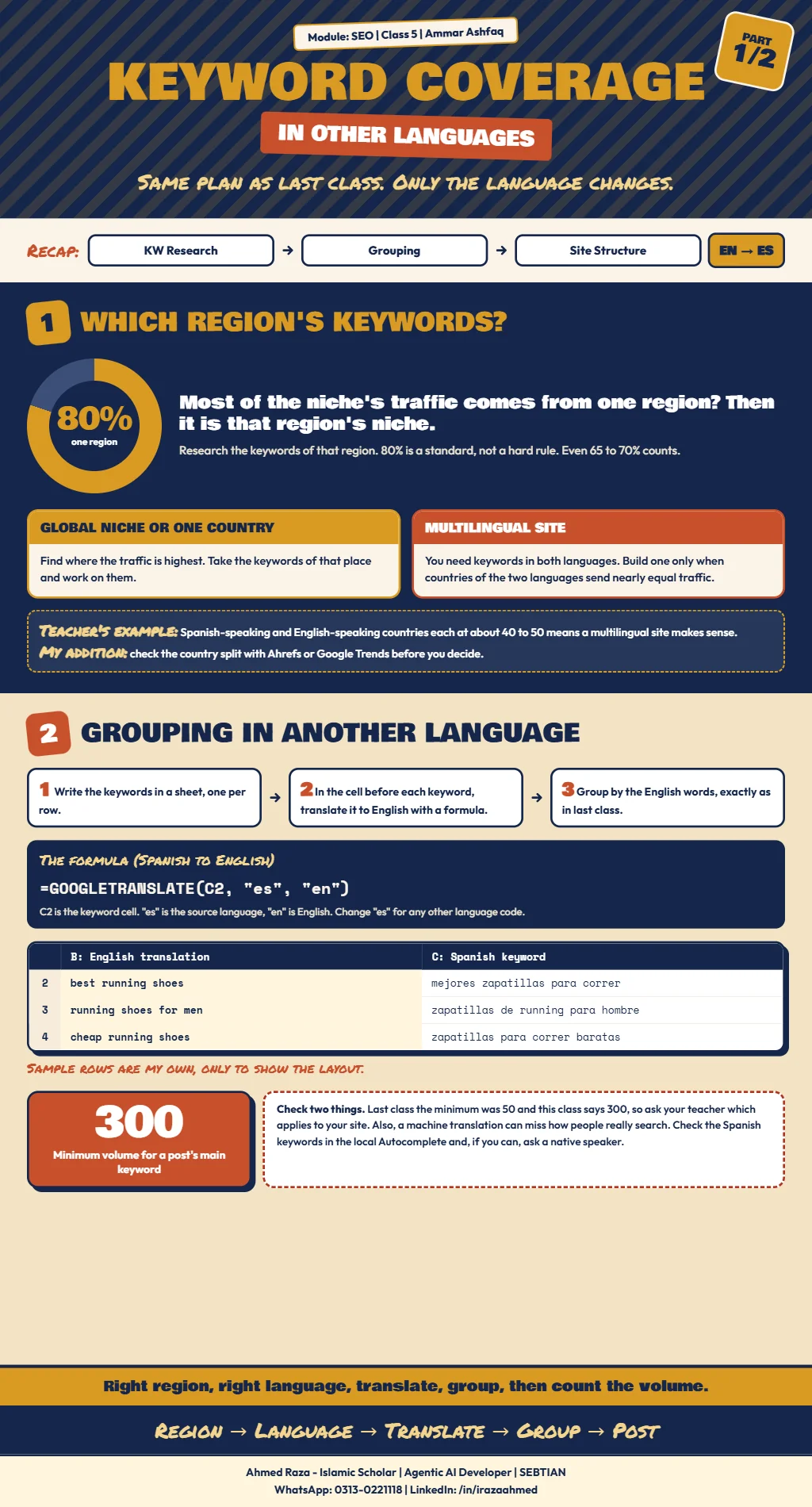 Keyword coverage and grouping, Class 5: keywords in other languagesOpen full size
Footnotes
More in this chapter2
- LessonContent and site planning, Class 3: from an approved niche to launchSir Tanveer Nandla's iSkills SEO Class 3 on keyword grouping, preparing ten articles, staging and hosting, choosing WordPress or a custom site, and launching with a strong user experience.Read lesson
- LessonContent coverage and grouping, Class 4: from a keyword list to site structureAmmar Ashfaq's SEO Class 4 on topical coverage, three ways to collect keywords, grouping them by search intent, and deciding which groups earn their own post to form the site structure.Read lesson