Content coverageLesson 4 of 4
Content coverage, Class 2: competitor keywords via Ahrefs, keyword grouping and Google Alerts
Sir Tanveer Nandla's Content Coverage Class 2: avoiding thin content and cannibalisation, the fourth content coverage source (competitors via Ahrefs), turning thousands of keywords into article topics, more keyword sources, and Google Alerts.
- Status
- stable
- Trust
- human-reviewedHuman: Ahmed Raza ·
This whole document is from Class 2 of Content Coverage in the SEO module, taught by Sir Tanveer Nandla.
Two things to avoid
- Thin content: content that has no value. Content is just filled in, but no value is added. We must not keep our content thin.
- Cannibalisation: when multiple pages of your site fight to rank on the same keyword. This is called cannibalisation, and it should not happen. You have to avoid it. This is the main focus of keyword grouping.1
Do not wait for perfection
Never stop while waiting for perfection. Don't be a perfectionist. Whatever is left, improve it later. For now, just go and do it.1
The sources of content coverage
- Google Instant / Autocomplete
- ChatGPT
- ChatGPT for keyword combinations for programmatic SEO
- Competitors via Ahrefs
We had already studied the first 3 (see Content coverage, Class 1). Today we look at the fourth.1
Source 4: competitors via Ahrefs
- Put the keyword into Google search, and take out your competitors from it.
- Put a competitor into Ahrefs.
- Take out its organic keywords and export them.
- Have ChatGPT make combinations of the keywords used in it. You can use these city-wise, or any other way.
- In the same way, sort the keywords in Ahrefs by position, to see where it is at the top.
- Then put those high keywords into groups, which makes the keyword combinations. This way we make thousands of keyword combinations.1
Tip
Instead of giving the AI one keyword at a time, export the complete keyword CSV and give it to the AI, and have the AI analyze it. You can also put keywords into Ahrefs Keywords Explorer and use their matching terms, export them, and have AI analyze them.1
Finding keywords is easy, making sense of them is the work
- Finding keywords is not hard now. The problem now is extracting meaningful data from them. We have to stay on our concise niche and work there.
- Keep the content relevant so it is not spam, but gives the user value.
- In summary: find the keywords, then have ChatGPT or Claude make templates of their combinations, and make the combinations of those keywords.1
The whole flow
Niche → Keyword Research → Thousands of Keywords found → Purify → Keyword Grouping → Article Topics1
More keyword sources
Mainly we will use the 4 sources above. Besides them, you can also take keywords from other places, such as:
- Google Trends
- Quora
- Google News: we will use this too, and it is important.1
Google Alerts
- Go to google.com/alerts.
- Write your keyword there, and set your region, language and everything else.
- Then whenever any news comes, you will get an alert from Google.
You must set alerts for yourself, so that whatever latest is happening in the world reaches you through Google News. This is the best option for keeping your content fresh.1
Assignment
Plan the complete keyword research for your niche, and complete it in one week.1
Class infographic
Class infographicTap the image to zoom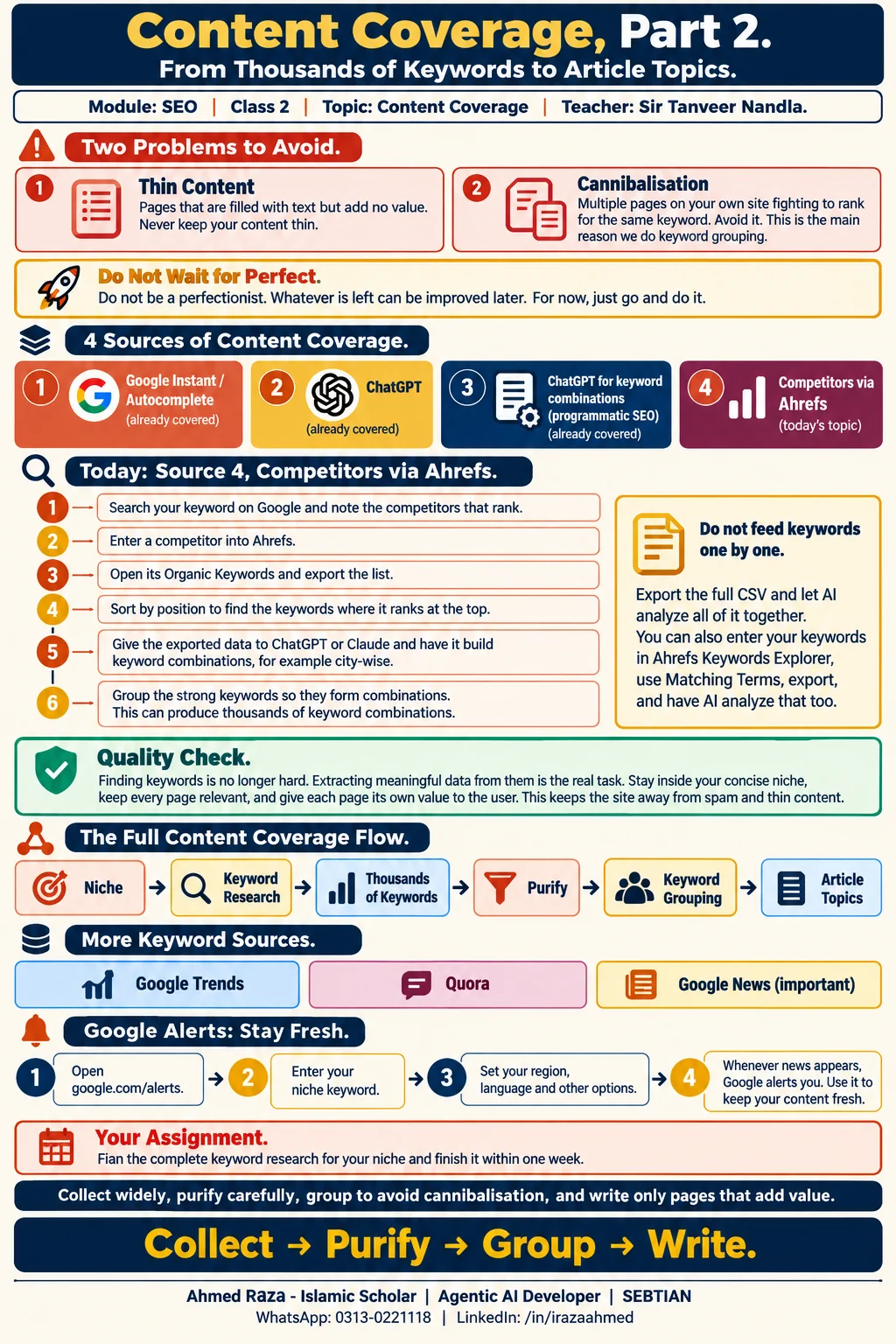 Content coverage, Class 2: competitor keywords via Ahrefs, keyword grouping and Google AlertsOpen full size
Footnotes
More in this chapter3
- LessonContent coverage: the 200-volume benchmark methodHow to fully cover a topic's sub-questions, group keywords without stuffing, and decide which of them earn a dedicated article.Read lesson
- LessonContent coverage, Class 1: related keywords, Google Autocomplete and programmatic SEOThe start of the Content Coverage module, turning one niche keyword into the related keywords a whole website is built on, with Google Autocomplete, an LLM prompt, entity combinations and programmatic SEO templates.Read lesson
- LessonContent coverage vs keyword coverage: ideas vs wordsSir Tanveer Nandla's lesson on the difference between content coverage (answering every question a reader has) and keyword coverage (using the phrases people actually search), with worked examples, a practice exercise, and how NicheSpark helps find the phrases.Read lesson
Content coverage vs keyword coverage: ideas vs words
Sir Tanveer Nandla's lesson on the difference between content coverage (answering every question a reader has) and keyword coverage (using the phrases people actually search), with worked examples, a practice exercise, and how NicheSpark helps find the phrases.
Grouping and site structure
Next Page