Finding nichesLesson 4 of 8
Finding niches, Method 4: backlink mining and UGC intent mismatches
Mining a giant authority site's newest backlinks to find fresh niche sites worth replicating, and using UGC sites like Reddit and Quora to spot intent mismatches worth building for.
- Status
- stable
- Trust
- human-reviewedHuman: Ahmed Raza ·
This whole document is from Class 10, Niche Research with a New Angle, taught by Muhammad Ali.
Smart work, not hard work
Think like the end user first: anyone building a real site also goes on to build a Facebook page, a LinkedIn page, and brand it properly, the normal sequence any legitimate business follows. That ordinary behaviour is the shortcut technique A below turns into a discovery method: a brand-new site betrays its own age by how recently it linked to Facebook, long before anyone would otherwise notice it exists.
A. Mining a giant's newest backlinks
The idea: instead of searching FOR niches directly, search for who just started acting like a real business, and the earliest, most reliable signal of that is a fresh link to Facebook, since setting up a page there is one of the first things a new site owner does.
- Open SEMrush and search facebook.com.
- Go to Backlinks: this lists every site that links to Facebook, which at that scale is effectively "every site that has bothered to set up proper branding."
- Check each linking site's First Seen and Last Seen dates: a site that both first and last linked to Facebook recently is a newly established site, not an old one that's been sitting there for years. These two dates together are what separate a brand-new competitor from background noise in a list that otherwise runs into the millions of rows.
- Apply a link placement filter, then export the newly-established sites specifically, narrowing the export down to just the ones that matter, rather than the whole backlink list.
- Hand the exported list to Claude (or another AI assistant) to analyze, then replicate whichever ones look promising.
This is a chore method in the sense that it takes going through a real list rather than a single clever filter, but it's exactly the kind of list a goldmine niche turns up in, precisely because almost nobody else is patient enough to look through it.
B. UGC sites as an intent-mismatch detector
Reddit and Quora are useful here as a detector, not a destination: if either one shows up ranking for a keyword, that keyword has an intent mismatch: what's actually ranking (a discussion thread) isn't what the searcher wanted (a direct answer or download), and that gap is the opportunity, the same intent-mismatch principle covered in Niche research: tools, metrics, and selection criteria. The logic is simple: Google only ranks a forum thread for a query when nothing better already exists to answer it, so a forum thread ranking well is itself proof that the gap is still open.
To find these systematically:
- Put a UGC site's domain (e.g.
reddit.com) into SEMrush and open its organic keywords: the full list of queries that domain ranks for at all, across every subreddit and thread. - Apply an "include" filter, either a specific word (e.g. "download") or the 5W1H words (why, what, who, how, where), to narrow that huge list down to queries that match the kind of niche worth building.
- Any keyword in the results where Reddit or Quora is genuinely ranking is a candidate intent mismatch: a real, measurable search volume with no dedicated page currently satisfying it properly.
Worked example: searching "Roblox Apk Download" and finding an Amazon page or a Reddit discussion thread ranking for it, instead of a direct download page, is an intent mismatch: a searcher who typed that query wanted a download, not a marketplace listing or a discussion about one, and the gap between what they wanted and what's ranking is the goldmine.
Class infographic
Class infographicTap the image to zoom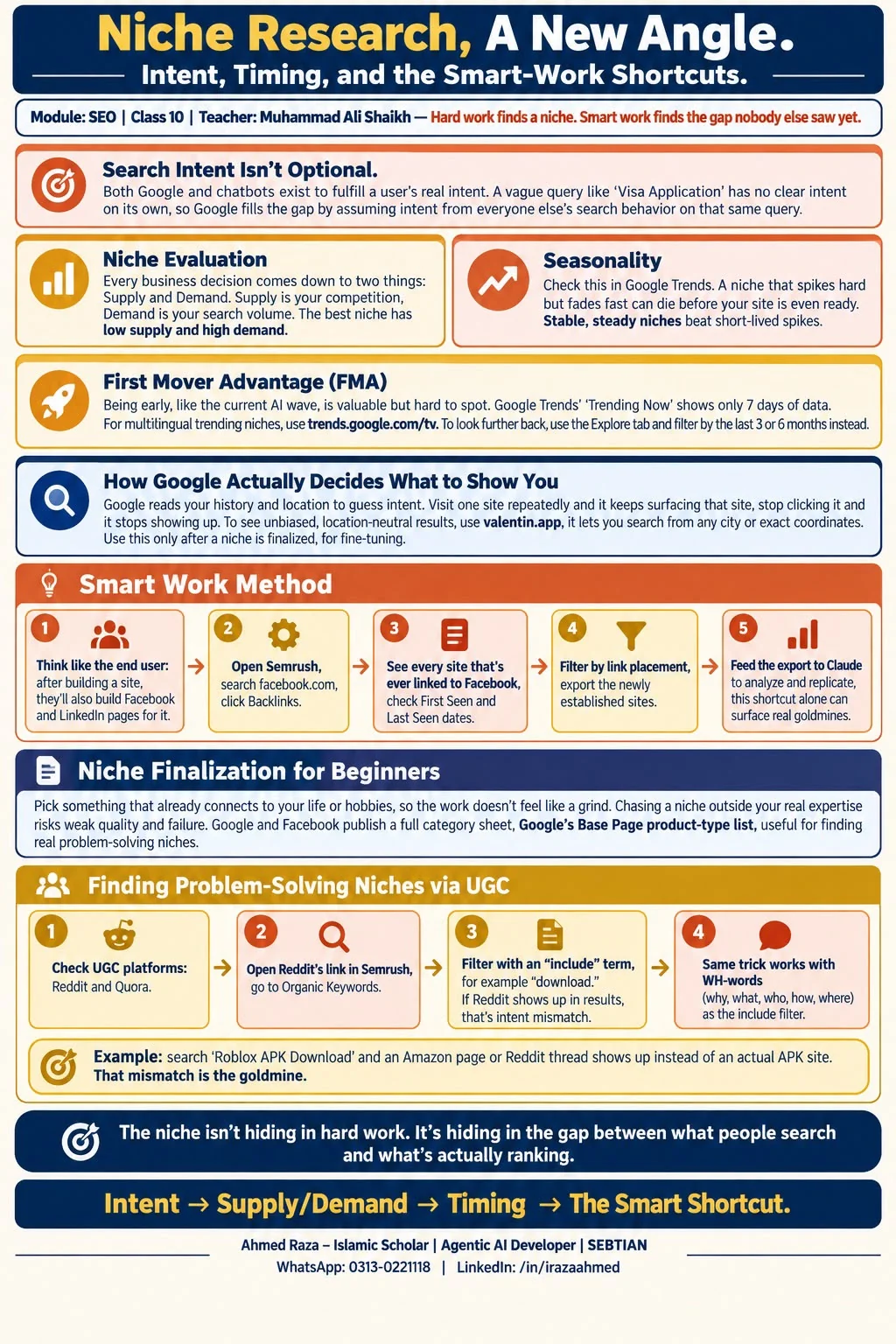 Finding niches, Method 4: backlink mining and UGC intent mismatchesOpen full size
More in this chapter7
- LessonFinding niches, Method 1: reverse-engineering marketplacesFinding a profitable niche by browsing site-selling marketplaces, reverse-engineering a successful site's keywords, and watching for brand hijacking.Read lesson
- LessonFinding niches, Method 2: the Ahrefs/SEMrush filter methodFinding a low-competition niche directly inside a keyword-research tool, using volume, DR, and word-count filters.Read lesson
- LessonFinding niches, Method 3: AI tools and NLP categoriesUsing ChatGPT prompts and Google's NLP content categories to brainstorm low-competition niche and sub-niche ideas.Read lesson
- LessonFinding niches, Method 5: SaaS and AI tool marketplacesReverse-engineering profitable SaaS, AI-tool, and app niches from marketplaces built for that stack: Acquire.com, Product Hunt, AppSumo, and the Chrome Web Store.Read lesson
- LessonFinding niches, Method 6: replicating one strong page from Ahrefs Content ExplorerUsing Ahrefs Content Explorer with a language filter and a low DR filter to find high-traffic pages, then building a dedicated website around one page rather than copying the whole site.Read lesson
- LessonFinding niches, Method 7: a topic search in Ahrefs Content Explorer, then reverse engineeringSearching a topic "everywhere" in Ahrefs Content Explorer, filtering to Domain Rating 0 to 20, and reverse engineering the best site's organic keywords and its competitors to find goldmine niches.Read lesson
- LessonAutomating niche research: Ahrefs MCP connected to ClaudeConnecting the Ahrefs MCP server to Claude so that the assistant finds goldmine keywords (DR under 20, AI related) and reverse engineers a site you want to replicate, with a better prompt giving a better answer.Read lesson
Finding niches, Method 3: AI tools and NLP categories
Using ChatGPT prompts and Google's NLP content categories to brainstorm low-competition niche and sub-niche ideas.
Finding niches, Method 5: SaaS and AI tool marketplaces
Reverse-engineering profitable SaaS, AI-tool, and app niches from marketplaces built for that stack: Acquire.com, Product Hunt, AppSumo, and the Chrome Web Store.