Finding nichesLesson 1 of 8
Finding niches, Method 1: reverse-engineering marketplaces
Finding a profitable niche by browsing site-selling marketplaces, reverse-engineering a successful site's keywords, and watching for brand hijacking.
- Status
- stable
- Trust
- human-reviewedHuman: Ahmed Raza ·
Taught by Sir Tanveer Nandla, except the "fuller version" paragraph below, from a niche-finding methods revision class taught by Sir Naveed Kalro.
Marketplaces that sell whole websites are a shortcut most people overlook: every listing on one has already been validated by a buyer's own due diligence, its traffic and revenue are disclosed up front, and browsing one is effectively browsing a curated shortlist of niches that are already proven to make money, rather than guessing at a niche and hoping it turns out to be viable.
The goal
- Find a low-competition (untapped) niche.
- Find a good competitor in it and replicate what works.
Step-by-step
- Browse marketplaces where people buy and sell websites: Flippa (flippa.com), Empire Flippers (empireflippers.com), Motion Invest (motioninvest.com), FE International (feinternational.com).
- Filter for high performers: sort by revenue, profit, traffic, or growth rate; look at content sites, SaaS, e-commerce, or dropshipping; choose categories like health, tech, finance, pets, fitness, or hobbies.
- Analyze a promising site with Ahrefs, SEMrush, or Similar Web: check its SEO, traffic sources, and backlinks, and identify what actually drives its traffic (organic search, paid ads, or social).
- Check keyword opportunities: in Ahrefs Site Explorer, enter the site's URL, look at its top-ranking keywords, and find ones with high search volume but low competition.
- Analyze monetization: see how the site earns (ads, affiliate, digital products, dropshipping) and which model fits the niche best.
- Validate demand and trends: check Google Trends for growth or decline, and check forums, Reddit, and Facebook groups for active discussion of the topic.
- Choose and validate: confirm consistent demand and more than one monetization option, and avoid saturated or declining markets.
Reverse-engineering directly
ahrefs.com → Site Explorer → paste the site URL → Keywords, then filter for
the best keyword. Example subject studied this way: capitalexotic.com
(Capital Exotics).
The fuller version of the same method (Method 1 of a niche-finding methods revision class taught by Sir Naveed Kalro), worth running on any established ("macro") site: open it in Site Explorer, review its top pages, pull the top keywords from whichever pages look strongest, then search those keywords on Google's own SERP. This is the path from a macro site down to a nano niche: one page on a big site can point you straight at a small niche worth owning outright.
Note
If reverse-engineering a tool like Ahrefs or SEMrush turns up no dedicated website for a specific micro-niche, that is not disqualifying. If the intent is clear, search volume is high, and Google Trends shows consistent searches over the past 12 months, a dedicated site for it can still be created: the gap itself is the opportunity.
Brand hijacking
Brand hijacking means targeting an established brand's name, keywords, or audience within a niche to capture its traffic and visibility. It can be intentional or unintentional, and shows up in SEO and affiliate marketing in several forms:
- Using brand keywords: content built around a well-known brand's name (e.g. "Nike Shoes Review") to capture its search traffic.
- Affiliate hijacking: ranking for brand-related keywords and redirecting users to affiliate products.
- Mimicking brand identity: a site, logo, or content designed to closely resemble a well-known brand, to borrow its credibility.
- Paid ads on brand names: running PPC ads on a competitor's brand name to intercept its clicks.
Class infographics
Class infographicTap the image to zoom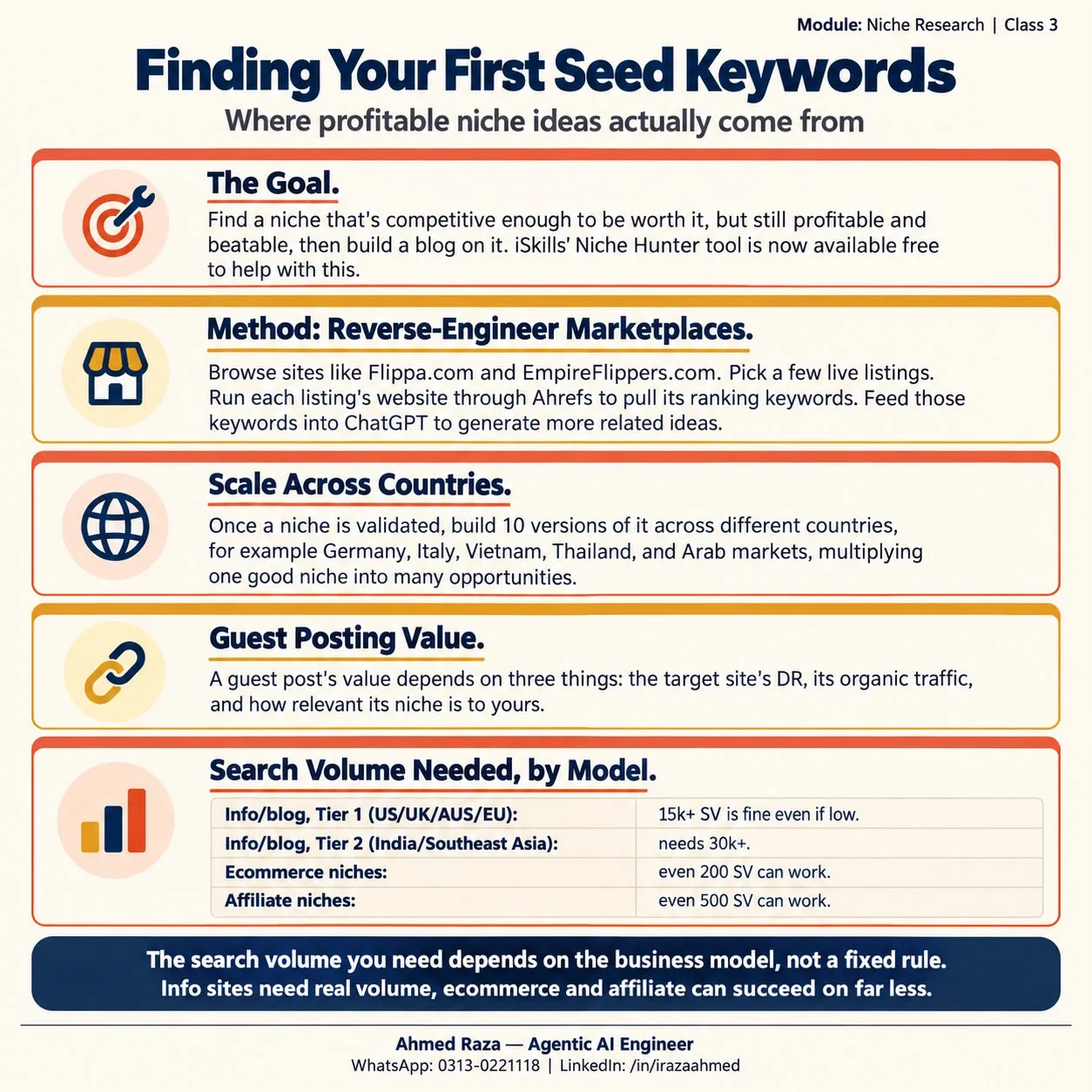 Class 3, finding your first seed keywordsOpen full size
Class infographicTap the image to zoom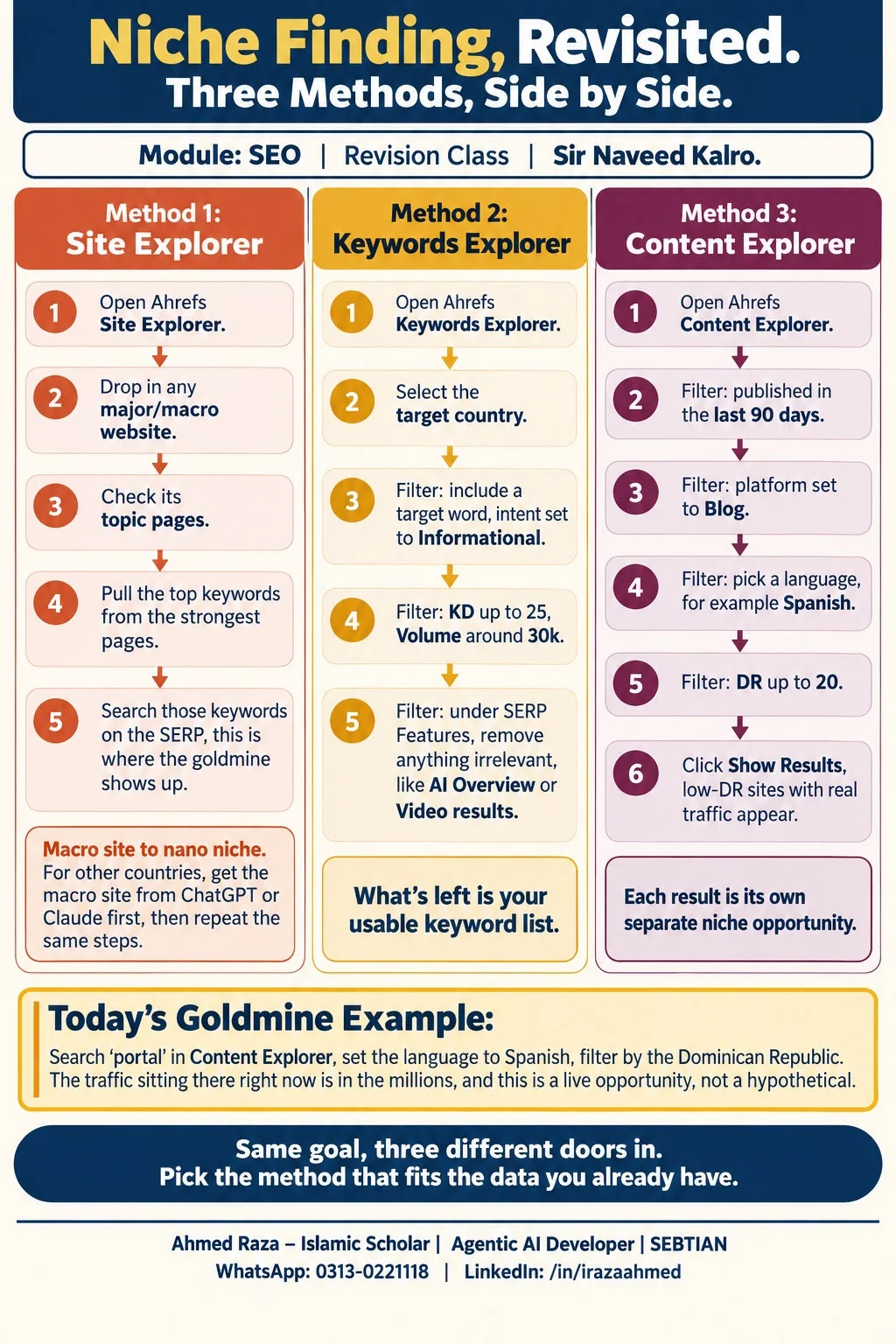 Niche finding revision class, three methods (Sir Naveed Kalro)Open full size
More in this chapter7
- LessonFinding niches, Method 2: the Ahrefs/SEMrush filter methodFinding a low-competition niche directly inside a keyword-research tool, using volume, DR, and word-count filters.Read lesson
- LessonFinding niches, Method 3: AI tools and NLP categoriesUsing ChatGPT prompts and Google's NLP content categories to brainstorm low-competition niche and sub-niche ideas.Read lesson
- LessonFinding niches, Method 4: backlink mining and UGC intent mismatchesMining a giant authority site's newest backlinks to find fresh niche sites worth replicating, and using UGC sites like Reddit and Quora to spot intent mismatches worth building for.Read lesson
- LessonFinding niches, Method 5: SaaS and AI tool marketplacesReverse-engineering profitable SaaS, AI-tool, and app niches from marketplaces built for that stack: Acquire.com, Product Hunt, AppSumo, and the Chrome Web Store.Read lesson
- LessonFinding niches, Method 6: replicating one strong page from Ahrefs Content ExplorerUsing Ahrefs Content Explorer with a language filter and a low DR filter to find high-traffic pages, then building a dedicated website around one page rather than copying the whole site.Read lesson
- LessonFinding niches, Method 7: a topic search in Ahrefs Content Explorer, then reverse engineeringSearching a topic "everywhere" in Ahrefs Content Explorer, filtering to Domain Rating 0 to 20, and reverse engineering the best site's organic keywords and its competitors to find goldmine niches.Read lesson
- LessonAutomating niche research: Ahrefs MCP connected to ClaudeConnecting the Ahrefs MCP server to Claude so that the assistant finds goldmine keywords (DR under 20, AI related) and reverse engineers a site you want to replicate, with a better prompt giving a better answer.Read lesson