Niche types and targetingLesson 5 of 5
Country and language targeting for niches
How to research niches for a specific country or non-English language, and the tier system that determines how much traffic from each is worth.
- Status
- stable
- Trust
- human-reviewedHuman: Ahmed Raza ·
This whole document is from Class 09, International Niche Research / Country code SEO, taught by Ammar Ashfaq.
Country-specific niche research
Country-targeted SEO matters because ranking in one specific region is usually far easier than ranking globally.
Steps:
- Use keyword research tools (Ahrefs, Google Keyword Planner, SEMrush) to find search trends in the target country.
- Change search engine settings to the target country and language for accurate keyword data.
- Analyze local competitors: their domain strength and backlinks.
- Check the Google SERP for your keywords in the local search engine version
(e.g.
google.com.mxfor Mexico). - Look for low-competition opportunities: topics with limited high-authority competitors in that country.
Country code SEO
A keyword's own search behaviour can make it low-competition without doing anything else. This is what "country code SEO" targets specifically. Two keywords can look equally generic and still behave completely differently:
- "Spotify Mod APK": searched by people all over the world. Global intent, global competition.
- "MEPCO bill check": searched almost entirely by people in one specific country (Pakistan, for a specific electricity provider). Because the audience is narrow, so is the competition.
The rule of thumb: if more than 80% of a keyword's search volume comes from one specific country, treat it as that country's keyword, not a global one. The SERP itself confirms this too: the same keyword returns a different SERP depending on which country you search it from.
This is a different axis from generic-vs-specific keyword wording. "Buy t-shirts online" reads as a generic keyword, but its intent is still narrow and commercial; generic wording and a specific intent are not the same thing, and either one (a narrow keyword, or a narrow intent) can be what makes a niche beatable.
Two ways to find a country-specific niche
Country-specific niche research comes down to the same two starting points every other niche research does (see Niche research: tools, metrics, and selection criteria): find the keyword directly (the same underlying idea as Method 2, the Ahrefs/SEMrush filter method), or find a site and reverse engineer it (the same underlying idea as Method 1, reverse-engineering marketplaces). Country code SEO just adds one filter to each of those two approaches: a country.
Approach A, keyword-first, in Ahrefs Keyword Explorer:
- Open Keyword Explorer and select the target country.
- Filter KD up to 20 and DR down to 20 (low).
- Add an "include" term relevant to the niche, e.g.
calcult*(a wildcard catching "calculate", "calculator", "calculation") for a tool niche.
Approach B, site-first, via ccTLD in Ahrefs Content Explorer:
- Set a target first: DR above 10 (so the site is real, not spam), traffic under 50,000 (so it's still beatable), language set to the target (e.g. PT, ES).
- Open Content Explorer with an empty search (no keyword typed).
- Apply those target filters, then add a Websites filter and set it to
the country's ccTLD (e.g.
.brfor Brazil). - Copy the resulting list of URLs and paste it into Ahrefs' Batch Analysis tool for the full metrics on all of them at once.
- Explore the results for the goldmine: a site worth reverse-engineering.
TLD vs ccTLD
- TLD (Top-Level Domain): a generic domain ending (
.com,.net,.org,.co), the right choice when targeting a generic (non-country- specific) keyword. - ccTLD (country-code Top-Level Domain): a country-specific ending
(
.pk,.in,.sg,.br), the right choice when targeting a country-specific keyword.
Finding a macro site per country
When you don't already have a macro site to reverse-engineer in a target country, ask ChatGPT or Claude to name one: an established, well-known site in that country's market. Then run it through Ahrefs Site Explorer the same way as any other macro site: check its top pages, pull their top keywords, and look for micro niches inside them.
Researching for other languages
Only about half of all Google searches happen in English; the other half split across every other language, so working English-only leaves half the demand untouched. Expanding into non-English markets surfaces untapped opportunities. Priority languages for SEO expansion: Spanish (ES), German (DE), French (FR), Portuguese (PT), Italian (IT), plus the language spoken in Saudi Arabia/UAE, and the languages preferred in Egypt and Holland.
Deliberately avoid Russian, Chinese, and Japanese, not because the demand isn't there, but because they weren't picked as target languages for this course's approach.
Note
Tier 1 countries pay the most per visit (see the tier table below), but don't ignore Tier 2 and Tier 3 because of that: the thing to optimise for here is language, not tier. A well-chosen Tier 2/3-country language still adds up at scale.
Tip
Download-focused niches (software tools, templates, plugins) often perform better than purely content-focused niches, in any language.
Process for finding better non-English niches:
- Detect the correct language variant with Google Translate: a word often has multiple regional versions, and not every country uses the same one.
- Focus on content, not just downloads.
- Look for rich, detailed meanings rather than literal translation.
- Remember each country has its own language variation.
- Search the translated term in Ahrefs.
- Pick a keyword (e.g. "Download") and check its exact local variation.
Refining steps:
- Copy the keyword and search it alongside famous brand names.
- Check whether that exact variation is used in the target language.
- If it is not used, there is a different, more natural local keyword.
- Filter results down to the best niches for that language.
Worked example (Mexico, in Ahrefs): KD ≤ 10, Volume ≥ 40K, DR ≤ 15.
Scaling one niche across countries
Once a niche is validated in one country, the same niche and structure can be repeated across several countries at once, e.g. building 10 versions of the same site for Germany, Italy, Vietnam, Thailand, and other target markets. Each copy still needs its own local keyword research and translation done properly (see above); it is the niche and the site structure that gets reused, not the content verbatim.
Tier system: revenue potential by country and language
Monetization depends on traffic source and user location: higher-tier countries generate more ad revenue:
- Tier 1 countries:
- English-speaking users: $15-20 per 1,000 visits
- Other-language users: $7-10 per 1,000 visits
- Tier 2 countries:
- English-speaking users: $6-10 per 1,000 visits
- Other-language users: $3-5 per 1,000 visits
- Tier 3 countries:
- English-speaking users: $2-4 per 1,000 visits
- Other-language users: $1 per 1,000 visits
Focus on Tier 1 countries for maximum ad earnings.
The full tier list, by country1
| Tier 1 | Tier 2 | Tier 3 |
|---|---|---|
| United States | Italy | India |
| Canada | Spain | Pakistan |
| United Kingdom | Portugal | Bangladesh |
| Australia | Greece | Nepal |
| New Zealand | Poland | Sri Lanka |
| Ireland | Czech Republic | Indonesia |
| Germany | Hungary | Philippines |
| France | Slovakia | Vietnam |
| Switzerland | Slovenia | Thailand |
| Sweden | Croatia | Malaysia |
| Norway | Estonia | Egypt |
| Denmark | Lithuania | Nigeria |
| Netherlands | Latvia | Kenya |
| Austria | South Korea | South Africa |
| Belgium | Japan | Brazil |
| Finland | Singapore | Argentina |
| Hong Kong | Chile | |
| Israel | Mexico | |
| United Arab Emirates (UAE) | Turkey | |
| Saudi Arabia | Morocco | |
| Qatar |
A country not on this list at all (most of Central Asia, most of Sub-Saharan Africa outside the ones named above, and several others) is simply not tiered by this course's own material; treat it as Tier 3 by default (the lowest per-visit rate, not a claim about search volume) until a better source says otherwise.
Practical example
For 10 pages targeting AI-related keywords, each getting roughly 1,000
visits/month: total traffic of about 88K visitors/month translates to
revenue via (traffic / 1,000) × RPM. Higher traffic combined with
low-competition keywords is what compounds into meaningfully more revenue.
Class infographic
Class infographicTap the image to zoom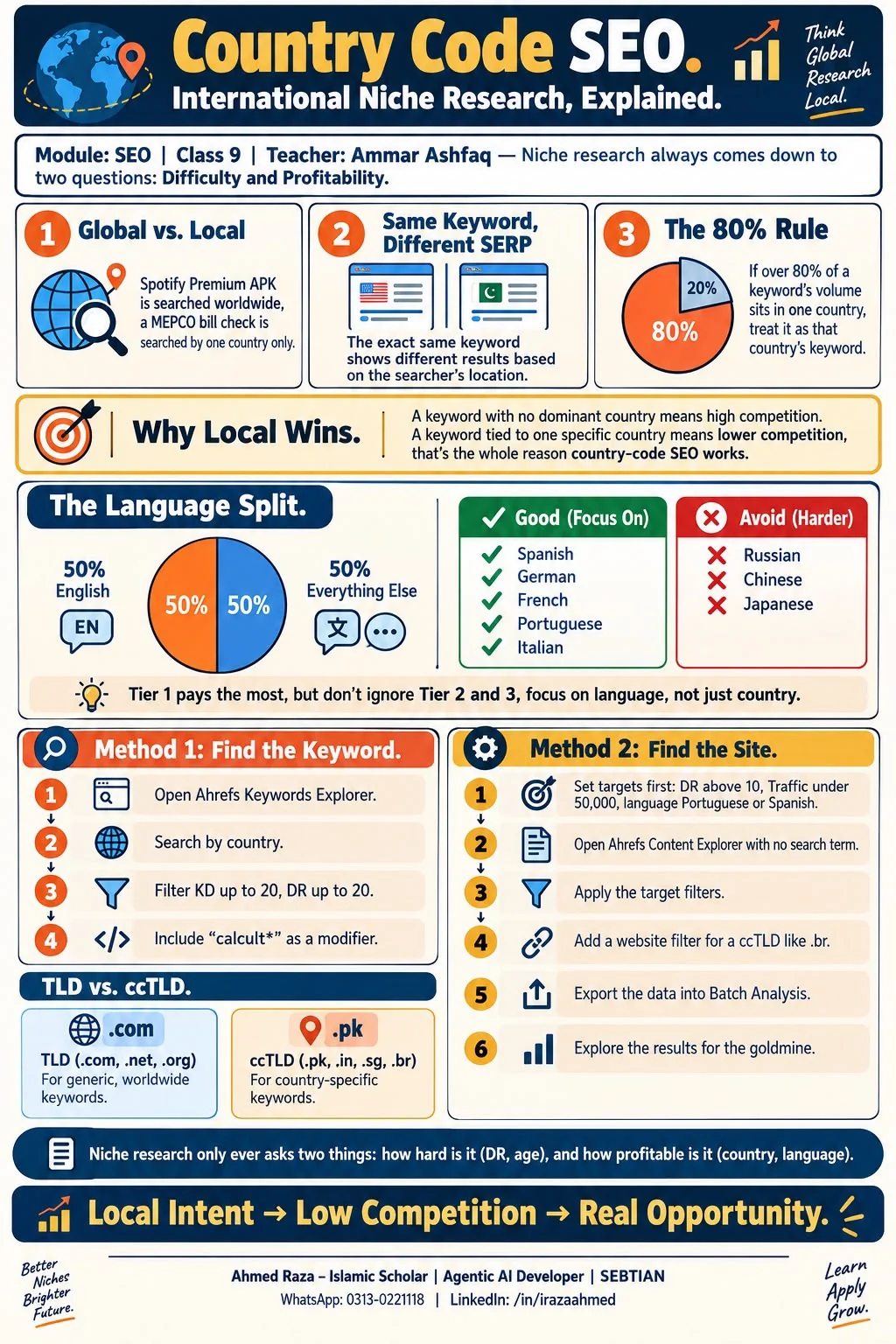 Country and language targeting for nichesOpen full size
Footnotes
-
Tiers Countries.xlsx, iSkills course material. ↩
More in this chapter4
- LessonAPK niche researchSelection criteria, budget, monetization, and legal considerations specific to running an APK download site as a niche.Read lesson
- LessonEasy-to-rank niche categoriesNiche categories that are consistently easier to rank than others (informational, downloadable, and government-related) plus finding them with Ahrefs Content Explorer.Read lesson
- LessonNiche keyword-combination matrixWord banks for a chosen niche (tool/app-type words, content-angle modifiers, and APK suffixes) that combine into a large set of content titles, blog topics, or app-store metadata.Read lesson
- LessonGoldmine niches reference listA curated list of real niche/sub-niche examples with their DR, monthly traffic, and monetization network, grouped by DR band, for calibrating what a beatable niche actually looks like.Read lesson